
Home » Cloud Computing (Page 2)
Category Archives: Cloud Computing
Microsoft Azure AD Identity Solution – Part-1 !!!
Microsoft Identity as a Service (IDaaS) for Enterprise Architects
“What IT architects need to know about designing Microsoft identity solution for customer while they deployed any public and private cloud (hybrid) with all types of cloud services such as IaaS, PaaS and SaaS“
Introduction
Cloud computing and mobile devices have transformed the modern digital workplace and Identity is the key foundation of our digital transformation journey today. Most of the businesses today are following a “cloud first” strategy, with lifting & shifting their existing infra and business applications into hybrid cloud, modernizing their business apps and opting in as-a-service models.
While cloud services are easy to deploy and commonly come with modern end users experience but this shift to digital transformation also introduces the new challenges (such as security risk, administrative burden and poor end users experience). Even, it becomes more challenging during the current covid-19 pandemic situation where most of businesses are opting in “work from home” to access their hosting applications in hybrid clouds.
Due to the nature of the business (i.e. manufacturing, utility, infrastructure, automotive etc.) and its gradual transition, the reality of most businesses will remain hybrid for many years, even if the enterprise’s workloads are moved into partners dc called “private cloud”, it’s still about running their legacy IT landscape and business apps on on-premises, alongside all the new SaaS services deployed in multi-tenant public clouds.
From the end user’s experience and IT/IS perspective, users must access their applications in both on-premises and cloud, and IT/IS must manage and protect applications in both places. Altogether with the shift to new way of working such as “work from home”, there is a need for providing a consistent end users experience, safeguarding the end users’ identities and management of hybrid cloud environment.
Providing seamless access and integration with wide range of legacy apps and modern SaaS service is the biggest challenge. So, enabling the single sign-on to modern SaaS services is just a simple part but the real challenge is supporting full range of services within multi-cloud hybrid environments. Even though various vendors offer their respective identity as service solution (such as Oracle, IBM, Google, Octa, CA, Ping Identity and so on.) but we will focus on Microsoft identity solution in this article in more detail.
Microsoft offers Azure AD – cloud-based Identity as a Service (IDaaS) and that comes with a comprehensive approach and single control pane of providing seamless access to users for all types of apps – SaaS, on-premises and custom-built apps.
The below figure depicts the detailed features of Azure Active Directory and their functionalities such as on-premises infra integration, user accounts, devices, partner collaboration with customer account management, application integration and administration.

Integrating Azure AD identity with Azure, AWS and GCP Hybrid Cloud
Azure AD integration with hybrid cloud provides a broad range of capabilities for business, the capabilities include but not limited to the following:
Azure identity solutions address challenges like safeguarding identities, improve user experience accessing applications seamlessly across platforms, and increasing administrative efficiency
One identity for all applications across cloud services (SaaS, PaaS, IaaS) across all cloud platforms such as Azure, AWS, Google etc.
Collaboration with partners by using Azure AD B2B and B2C
Synchronization or federation with on-premises directory through Azure AD connect
Enables single sign-on and multi-factor authentication
Integration with web-based applications located on-premises through application proxy
Use either Azure AD domain services (Azure AD DS) for authenticating to line of business (LOB) applications hosted on virtual machines in Azure IaaS or extend on-premises active directory domain service (AD DS) to Azure IaaS
Azure identity provides cloud apps discovery and management through Azure AD ‘MyApps’ panel as single control pane
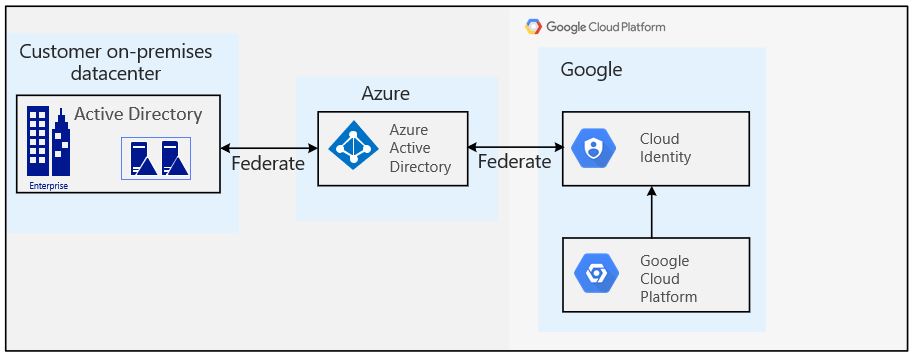
Below figure shows the Azure AD integration with hybrid cloud respectively Azure, AWS and Google:


Rajeev Ujjwal has more than 18 years of transformation delivery experience in cloud computing, infrastructure, directory service, and cyber security with larger global customers. He is a senior cloud consultant and successfully delivered various kind of global project delivery such as greenfield, consolidation, separation and migration.
Co-existence between Azure Virtual WAN and SD-WAN is shifting a gear in the digital transformation
Introduction:
Last year in November, Microsoft has released a new networking services named as Azure Virtual WAN as a general availability. This is an additional service over existing services such as ExpressRoute, Site-to-Site, Point-to-Site VPN and few more, these earlier services are responsible for connecting or extending the customer on-premises data centre’s or branch office network into azure public cloud.
It’s not only Microsoft and even its major competitors such as Amazon and Google are bringing some major services (may not exactly the same) towards to the similar model. AWS recently launched its Transit Gateway, which is greatly simplifying the process of routing between VPCs and customer on-premises network. Google Cloud Platform too allow for virtual private connectivity on directly into their backbone
Prior we proceed to further have a deep dive into Azure Virtual WAN, Lets go a decade back and discuss about the network connectivity.
Traditional MPLS and IPSec used as a corporate WAN:
Let’s have some light on how widely MPLS along with IPSec VPN networks are/were deployed, particularly in large global enterprises. this was the standard approach for building a on-premises corporate WAN where all customer data centres and branch offices are getting connected and access their business and infra applications to operate their business, sometimes IPsec VPN were used as a backup service and even used for remote sites to connect where MPLS was either too expensive or not feasible.
Not even that, there are physical constraints imposed by the propagation time over large distances, and the need to integrate multiple service providers (including multi-clouds) to cover global geographies, MPLS face important operational challenges, including network congestion, packet delay variation, packet loss, and even service outages.
Current huge demand in digital transformation and it’s modern applications such as, IoT, machine learning, data science, analytics, VoIP calling, videoconferencing, streaming media, and virtualized applications require low latency. Bandwidth requirements are also increasing, especially for applications featuring high-definition video and sudden hike in data growth. It can be expensive and difficult to expand MPLS corporate WAN capability, with corresponding difficulties related to network management and troubleshooting.
The role and importance of cloud exchange providers:
While connecting to Public Clouds, customer has to depends on Cloud Exchange Provider to have established connectivity between On-Premises MPLS and Public Cloud VNet/VPC, in this scenario latency becomes a challenge for business to connect their branch offices/remote sites into public cloud to access their applications. At the same time the data centre connectivity was seamless (via ExpressRoute /DirectConnect) and it’s allowed business to migrate and access their applications into cloud.
In the meanwhile, many players had emerged and have started to offer on-demand global interconnectivity and becomes network hub to reach/connects most of public and private clouds along with on-premises data centres and even terminate these connection into corporate MPLS network. Now, business is allowed to migrate/host their business application based on their choice, flexibility and needs. It’s was the time where customer can host/migrate their enterprise application between multi-cloud service providers and create their seamless hybrid cloud platform but the real business challenges about latency, cost and others for accessing their cloud application from remote sites/ branch offices are still present
Another evolution and revolution in the network landscape:
On the other side, as cloud computing and mobile device has transformed the modern digital workplace, digital transformation is now taking major shift in the networking landscape. the cloud computing has evolved the terminology “as a service” several years back and that becomes mature and reality in the today business.
In the current digital transformation era, the dynamic (on-demand) provisioning and scaling of network capacity and slicing the network resources is now more aligned and satisfying the current enterprise needs. Likewise, the automation has gained the presence in the cloud, the Network-as-a-services (NaaS) has evolved into new phase and becomes a potent technology in a very short period of time.
the virtualized network function (VNF) as a software-based services, software defined networking, network as-a-service and 5G/Edge computing are the emerging trends in the network services, and those are adding another revolution remark in digital transformation industry, in the similar line of software-defined networking revolution, the SD-WAN has emerged and become a new digital transformation pillar which address the traditional MPLS limitation and challenges
SD-WAN simplifies the management and operation of a traditional corporate WAN by decoupling the networking hardware from its control mechanism. This concept is similar to how software-defined networking implements virtualization technology to improve data center management and operation.
A key application of SD-WAN is to allow organization to build higher-performance WANs using lower-cost and commercially available Internet access, enabling businesses to partially or wholly replace more expensive corporate WAN connection technologies such as MPLS
As per research firm Gartner prediction in 2018, by 2023 more than 90 percent of WAN edge infrastructure refresh initiatives will be based on virtualized customer premises equipment (vCPE) platforms or SD-WAN software/appliances
Azure Virtual WAN goes hand in hand with Partner’s SD-WAN/vCPE NVA:
Now we are entering into a new emerge model which is taking the cloud connectivity to the next level where the cloud is moving closer to the business and on other side the business moving closer to the cloud. So, we foresee a new gear shift where the existing MPLS WAN will be transformed to a SD-WAN based network. Precisely, you might have observed a parallel thread is running where all major cloud service providers are building their own network presence globally.
Microsoft, Google and Amazon are rapidly increasing their global network reach and created their own global network backbone and that has large number of PoPs/Edges locations across globe and these are very close to business enterprise. In other words, we will eventually see a compelling alternative to traditional MPLS providers where the connectivity is served directly into the business by cloud service provider. This kind of transition is already witnessed with AWS. AWS now allows the companies to run AWS infrastructure in their own private data centers.
Microsoft Azure Virtual WAN has brought a WAN-centric service to the market last year that brings many networking (utilizing their existing services such as ExpressRoute/Site-to-Site VPN), security, and routing functionalities together to provide a single operational interface. These functionalities include branch connectivity (via connectivity automation from Virtual WAN Partner devices such as SD-WAN or VPN CPE), Site-to-site VPN connectivity, remote user VPN (Point-to-site) connectivity, private (ExpressRoute) connectivity, intra-cloud connectivity (transitive connectivity for virtual networks), VPN ExpressRoute inter-connectivity, routing, Azure Firewall, and encryption for private connectivity.
Summary:
Initially you might not need all of these Azure Virtual WAN functionalities to start using Virtual WAN. You can simply get started with just one or two, and then adjust further your network as it evolves. The Virtual WAN architecture is a hub and spoke architecture with scale and performance built in for branches (VPN/SD-WAN devices), users (Azure VPN/OpenVPN/IKEv2 clients), ExpressRoute circuits, and virtual networks. It enables global transit network architecture, where the cloud hosted network ‘hub’ enables transitive connectivity between endpoints that may be distributed across different types of ‘spokes’.
The Virtual WAN key promising is the potential for API-based integration with various SD-WAN solutions (various third party such as Cisco Meraki, Citrix, Fortinet, Barracuda Networks, Check Point etc.), that would allow for the encrypted tunnel creation process to be automated. A branch office would connect to their nearest PoPs and this would automatically allow the branch to communicate with the rest of the global WAN.
To have further more insight technical details about Azure Virtual WAN design and architecture, Refer to below article:
Microsoft Azure Virtual WAN – How it’s getting closer to Business!
Rajeev Ujjwal has more than 18 years of transformation delivery experience in cloud computing, infrastructure, directory service, and cyber security with larger global customers. He is a senior cloud consultant and successfully delivered various kind of global project delivery such as greenfield, consolidation, separation and migration.
 Technology Blog